

 Facebook
 X
X
 Pinterest
 Copy Link
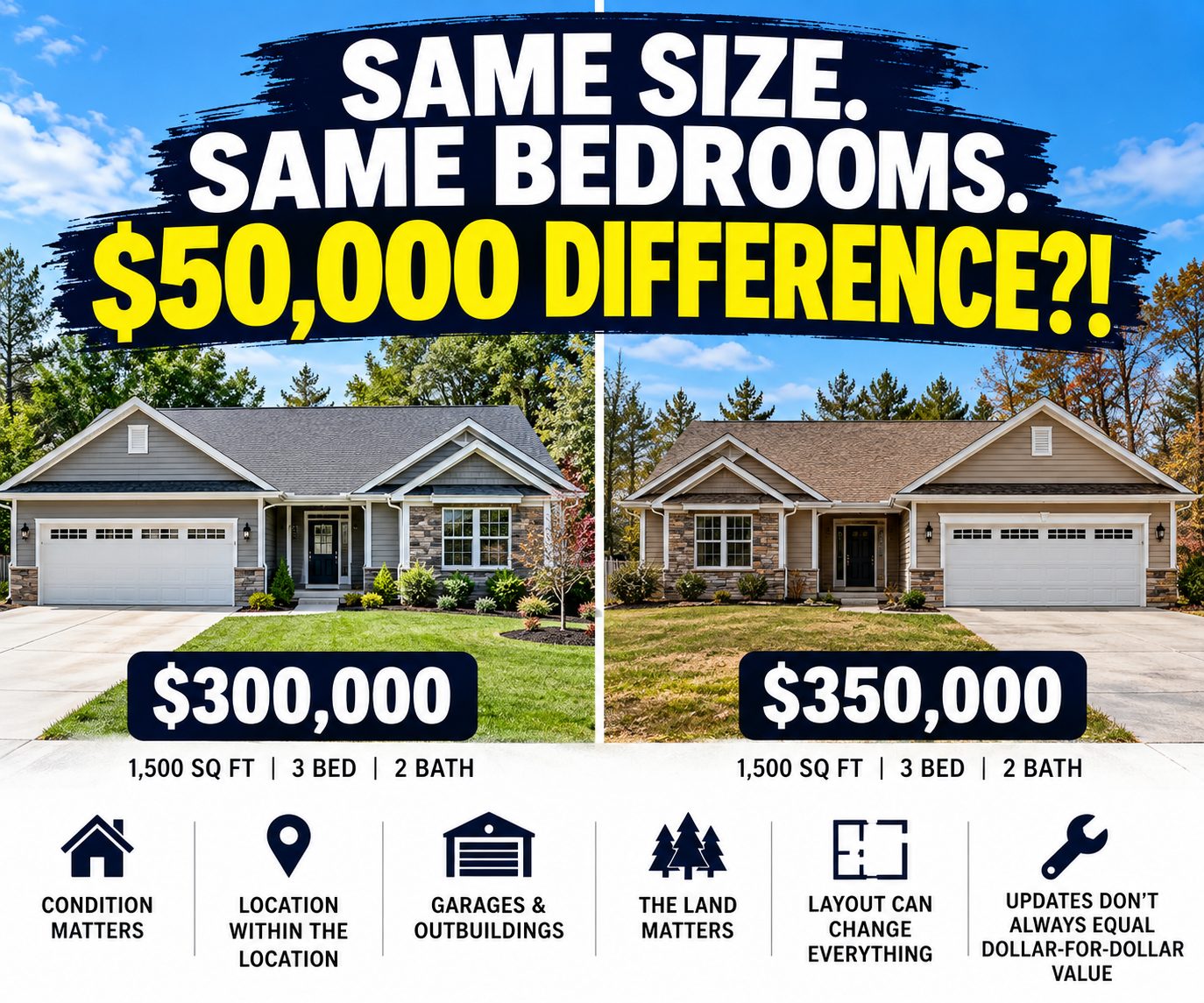
Have you ever looked at two homes online and wondered:
“How did that house sell for $50,000 more? They’re almost the same!”
Maybe they have similar square footage. The same number of bedrooms and bathrooms. They might even be right down the road from each other.
But when it comes to real estate, similar doesn’t always mean equal.
Here are some of the things that can make a BIG difference in what a home is actually worth.
CONDITION MATTERS
Two homes can look nearly identical on paper but be completely different once you walk through the door.
One may have a newer roof, updated electrical, newer plumbing, modern heating and cooling, and a remodeled kitchen and bathrooms.
The other may need $40,000 or $50,000 worth of work.
Those houses aren’t worth the same just because they’re the same size.
LOCATION WITHIN THE LOCATION
Even homes in the same neighborhood can have different values.
One might sit on a quiet road with a beautiful backyard while another backs up to a busy highway.
Water frontage, water views, proximity to public land, road type, neighboring properties, school district, and even the specific setting can affect what buyers are willing to pay.
GARAGES AND OUTBUILDINGS COUNT
Especially here in Michigan, garages, pole barns, workshops, sheds, and other outbuildings can add significant value.
A 1,500-square-foot house with no garage isn’t necessarily comparable to another 1,500-square-foot house with a three-car garage and a large pole barn.
THE LAND MATTERS TOO
A house sitting on a half-acre and the same house sitting on 10 acres are two very different properties.
But more acreage doesn’t automatically mean every additional acre has the same value.
The type of land, usability, road frontage, wetlands, woods, hunting potential, privacy, and location all matter.
LAYOUT CAN CHANGE EVERYTHING
Square footage only tells part of the story.
A well-designed 1,500-square-foot home can sometimes feel larger and function better than a poorly designed 1,800-square-foot home.
Buyers pay attention to things like bedroom sizes, closet space, kitchen layout, primary suites, laundry location, mudrooms, and how easily rooms flow together.
UPDATES DON’T ALWAYS EQUAL DOLLAR-FOR-DOLLAR VALUE
Spending $30,000 on improvements doesn’t necessarily increase your home’s value by $30,000.
Some improvements add considerable value.
Others make the home easier to sell.
And some improvements simply reflect the current owner’s personal taste.
That’s an important distinction.
THE DETAILS ADD UP
Basements. Garages. Bathrooms. Acreage. Age. Condition. Outbuildings. Mechanical systems. Updates. Location. Layout.
One difference might only change the value a little.
But several differences together can create a surprisingly large gap between two homes that initially looked almost identical.
THAT’S WHY PRICING A HOME ISN’T JUST ABOUT PRICE PER SQUARE FOOT
Determining market value means looking at the whole property and comparing it carefully against homes that have actually sold.
A computer can tell you that two houses are both 1,600 square feet with three bedrooms and two bathrooms.
It can’t always see that one has a new roof, a finished basement, five acres, a pole barn, an updated kitchen, and a much better setting.
Those details matter.
If you’re thinking about selling and wondering what your home might actually be worth, don’t base your decision on the house down the road—or an online estimate.
Let’s look at the details, look at the actual market, and price it right.
Charles Hughes
Michigan’s Broker
Hardworking. Honest. Client Focused.
Helping people live their dreams.
