

 Facebook
 X
X
 Pinterest
 Copy Link
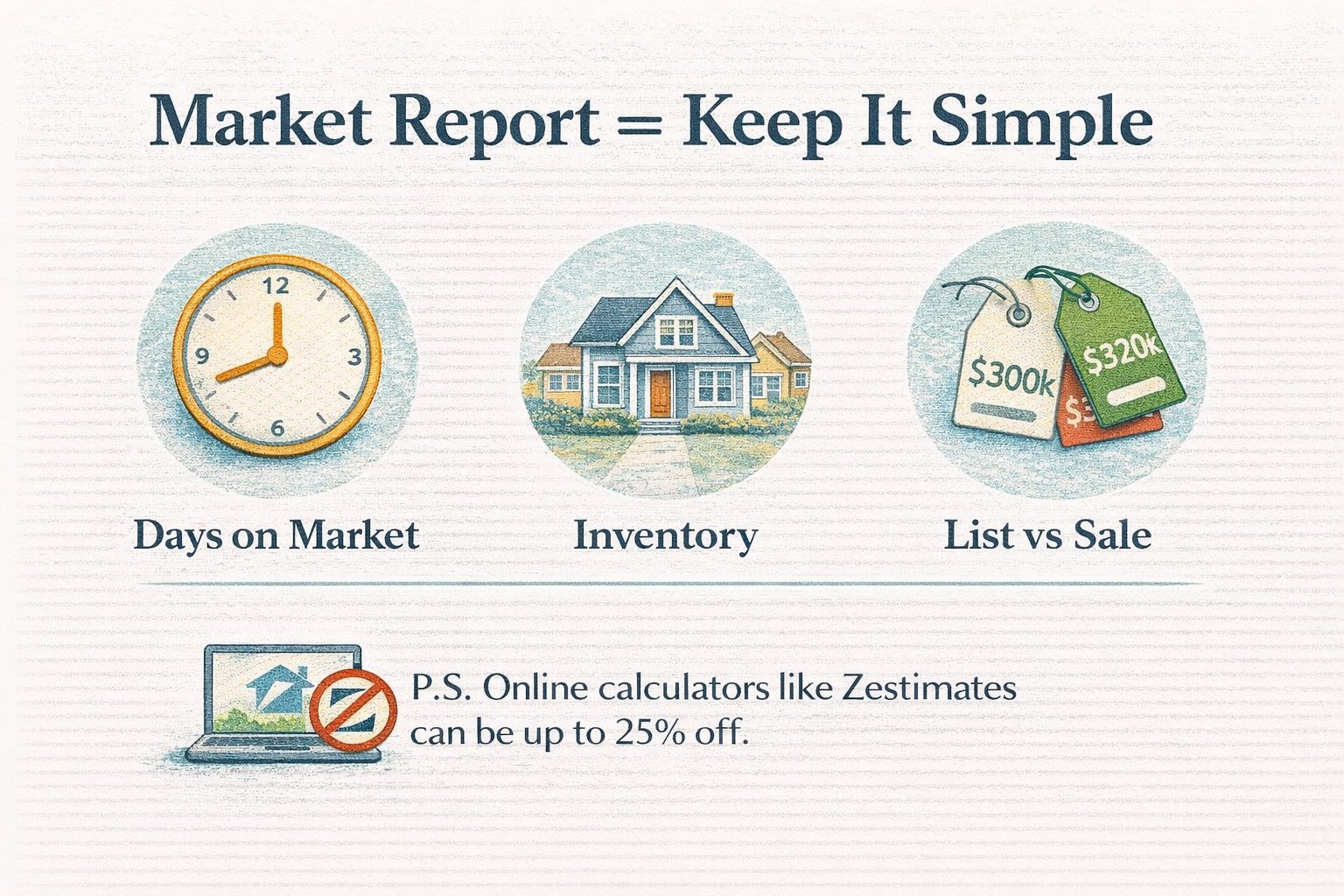
Market reports are everywhere.
You’ll see headlines like:
- “Prices Are Up!”
- “Inventory Is Down!”
- “Market Is Shifting!”
But here’s the problem:
Most of it is noise.
If you don’t know what you’re looking at, it’s easy to feel overwhelmed — or worse, make decisions based on incomplete information.
Let’s simplify it.
What a Market Report Is (In Plain Terms)
A market report is just a snapshot of:
- How many homes are selling
- How fast they’re selling
- What they’re selling for
That’s it.
Everything else is interpretation.
The 3 Numbers That Actually Matter
If you focus on just these three, you’ll understand more than most people.
1. Days on Market
This tells you how fast homes are selling.
- Lower = homes are moving quickly
- Higher = homes are taking longer
Why it matters:
It shows how competitive the market is.
2. Inventory (Number of Homes for Sale)
This is simply how many homes buyers have to choose from.
- Low inventory = more competition
- High inventory = more options
Why it matters:
It directly affects pricing and negotiation power.
3. List Price vs. Sale Price
This shows how close homes are selling to asking price.
- Close to asking (or above) = strong demand
- Below asking = more room to negotiate
Why it matters:
It tells you how realistic pricing needs to be.
A Quick Note on Online Estimates
A lot of people try to shortcut market data by looking at online estimates like Zestimates.
They can be helpful as a starting point — but they’re not precise.
In some cases, automated estimates can be off by a wide margin — sometimes 10–25% or more depending on the home, condition, and local data available.
Why?
Because they can’t see:
- Condition
- Updates
- Layout
- Location nuances
They’re pulling from data — not actually evaluating the home.
That’s why market reports and real, local comparisons matter more than any single online number.
What People Get Wrong
❌ Focusing Only on Price
Just because prices are up doesn’t mean it’s a “hot” market.
❌ Listening to National Headlines
Real estate is local.
❌ Overreacting to Small Changes
Markets move in trends, not straight lines.
The Better Way to Use Market Reports
Instead of asking:
“Is the market good or bad?”
Ask:
“What is the market telling me right now?”
Bottom Line
Market reports aren’t meant to confuse you.
They’re meant to give you clarity.
When you focus on:
- Speed (Days on Market)
- Supply (Inventory)
- Pricing (List vs Sale)
And understand that online estimates are just rough guides — not final answers —
You start making decisions based on real insight, not headlines.
